
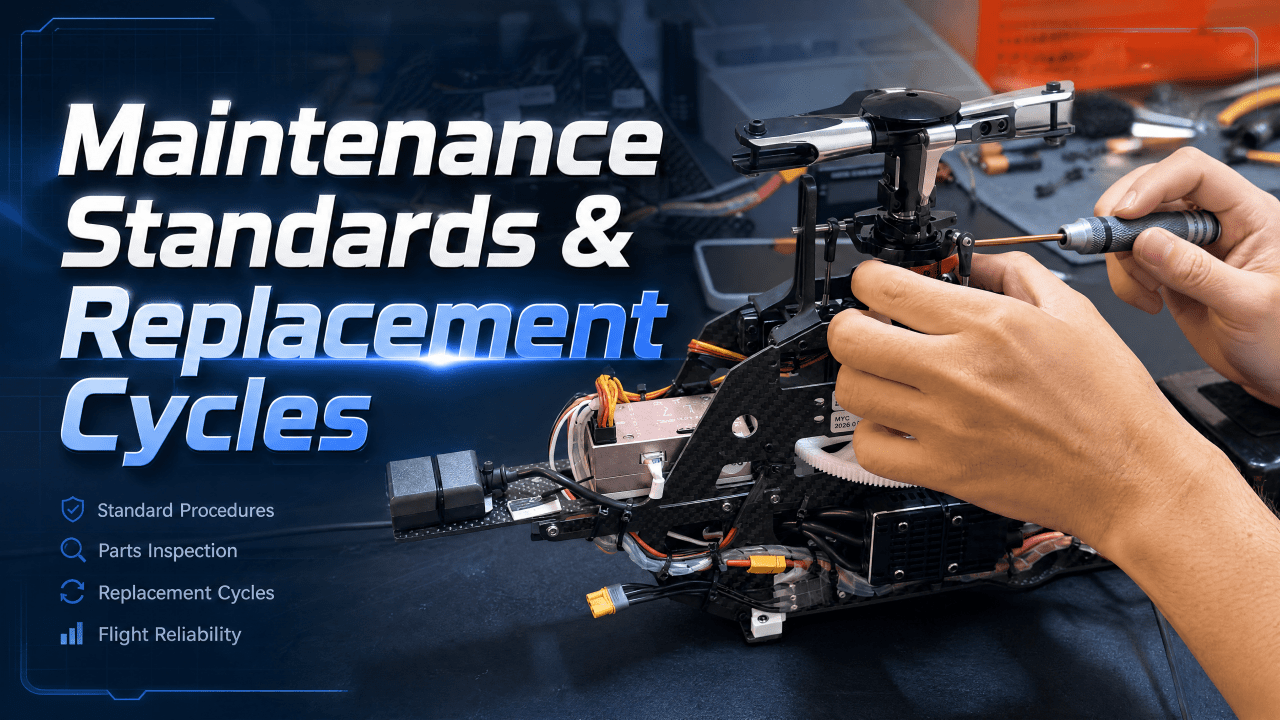
Official Guide for Crash Prevention & Airworthiness
CRITICAL FOREWORD Class 450 and larger electric RC helicopters are high-speed, high-load professional aircraft. Therefore, metal load-bearing components—such as feathering shafts, main shafts, drive gears, and linkage rods—do not possess lifetime attributes. Because metal fatigue is an irreversible physical phenomenon, it never constitutes a product quality defect. Consequently, all load-bearing parts have a finite operational lifespan. As a result, structural failure, mid-air disintegration, or crashes resulting from a failure to replace parts on schedule are classified as improper player maintenance. Thus, they are strictly excluded from our free warranty. Ultimately, your flight operations signify full acknowledgment and acceptance of these maintenance regulations.
1. Core Fatal Load-Bearing Components
Failure of these components will result in an immediate, catastrophic crash.
-
Applicable Components: Feathering Shaft (Spindle Shaft), Main Shaft, Blade Grips, and Power Output Shaft.
-
Replacement Cycle for Daily Mild Flight: We recommend checking and replacing these parts after 30–50 cumulative flights or 30 flight hours.
-
Crucial Safety Note: These components constantly endure intense rotor lift, structural vibration, and landing impacts. However, internal micro-cracks cannot be detected by the naked eye. Therefore, they must be treated as invisible, high-risk wear items that require preemptive replacement.
2. Drivetrain & Linkage Wear Items
Degradation here severely affects flight stability and will indirectly cause a crash.
-
Applicable Components: Main Gear, Tail Drive Gear, Swashplate Linkage Rods, Metal Servo Arms, Ball Links, and Drive Shaft.
-
Replacement Cycle: Similarly, for mild flight styles, you must inspect and replace these components after 30–50 cumulative flights or 30 flight hours.
-
Operational Criteria: You should replace parts immediately if you notice slight binding, increased backlash, minor gear wear, or loose ball links. In short, you must never fly a compromised aircraft.
3. Propulsion & Landing Gear Components
These represent routine wear-and-tear parts.
-
Main & Tail Rotor Blades: You must inspect these components before every single flight. Furthermore, you must replace them immediately if any scratches, micro-cracks, deformation, or paint peeling appear.
-
Structural Hardware & Screws: High-frequency vibrations easily cause thread stripping and loosening over time. Consequently, you must re-torque and check all screws every 10 flights. Additionally, you should perform a comprehensive teardown inspection and replace all hardware with brand-new screws every 100 flights.
4. Electronics & Consumables
Proactive maintenance here is critical for preventing loss-of-control (LOC) crashes.
-
LiPo Batteries: You must mandatorily retire batteries after 30–50 charge cycles. Moreover, you should replace them immediately if the pack shows signs of puffing, rapid voltage drops, or a sudden plunge in flight time.
-
Servos: We recommend inspecting the internal gears and centering response after 40 cumulative flight hours. Ifyou experience any binding, poor centering precision, or excessive slop, you must replace the servo directly to avoid losing control mid-air.
5. Hard Rules of Maintenance (Warranty Determination Core)
-
Metal Fatigue is Irreversible: Internal micro-cracks in metal shafts are completely invisible. For this reason, component lifespans cannot be predicted by manual inspection alone, meaning parts must be replaced strictly on schedule.
-
Extended Use Risks: If you choose to fly past the recommended cycle, you do so entirely at your own risk. Consequently, crashes, total airframe loss, or collateral damage caused by metal fatigue are 100% attributed to improper maintenance. Therefore, no warranty, compensation, or free after-sales service will be provided under these circumstances.
-
Mandatory Post-Crash Overhaul: Whenever a crash, hard landing, or severe ground strike occurs, all metal shafts and drivetrain parts must be replaced entirely, regardless of their visual appearance. Because severe impacts generate hidden metal fatigue, reusing these parts will inevitably cause a secondary crash.
6. Official Recommendations
Class 450+ helicopters are professional-grade machinery, not toys. Thus, scheduled parts replacement is not a sign of poor product quality, but rather a fundamental maintenance practice for professional pilots. To support you, we provide a full inventory of original factory parts. In addition, we offer free maintenance inspections and parts replacement tutorials to help you mitigate crash risks while extending your aircraft’s operational lifespan.